Capitol Update - March 5, 2026
UEN Legislative Update
March 5, 2026
(Download this week's printable UEN Legislative Written Report)
This UEN Weekly Report from the 2026 Legislative Session includes:
- A Note about School Funding
- Highlight on Charter Schools: Status and Comparison of Details
- UEN Priorities Moving
- Other Post-Funnel Floor Work (spot the unfunded mandates still moving)
- Property Tax Discussions continue in the Senate: SSB 3001 Senate Republican Plan gets a Hearing
- Advocacy Actions for the Week
- Advocacy Resources
A Note About School Funding
SF 2201, setting SSA at 2%, is done and signed by the Governor. However, the lingering impact of the 6th consecutive year of an SSA increase that lags inflation is still felt, even more so with both the House and the Senate passing unfunded mandates. This low SSA rate leaves 89 school districts with negative regular program district cost (that’s an actual budget cut, even considering budget guarantee), and for those on budget guarantee, including 19 of 24 UEN districts, staff salary and benefits increases are likely to exceed the 1% budget protection guaranteed to your district this year, only delaying further reductions until next year.
Remind legislators that with every unfunded mandate, this does not just violate the principle of local control, but actually requires staff time, funding, and energy taken away from important initiatives, such as the State’s new literacy and mathematics plans, expansion of work-based learning and career and technical education credentials, and district learning goals established by your school board. Tell legislators to “JUST SAY NO” to more unfunded mandates. See the ISFIS New Authority Report for the impact on your district of the 2% increase. The Tool also shows the impact on categorical funds, and media and education services.
Highlight on Charter Schools: Similarities and Differences
HF 2699, Governor’s Charter Schools, and HF 2713, Bigger School Choice with Charter Schools, are both assigned to the House Appropriations Committee. HF 2699 was reviewed by a Subcommittee this week, with recommendations to move the bill forward. SF 2406, Governor’s Charter Schools, and SF 2425, Bigger School Choice with Charter Schools, were both approved by the Senate Education Committee in mid-February and have been assigned to the Senate Calendar since. UEN is registered opposed to all four bills. The following is a comparison of bill provisions and UEN positions on each. The rows shaded green are the provisions shared by all proposals:
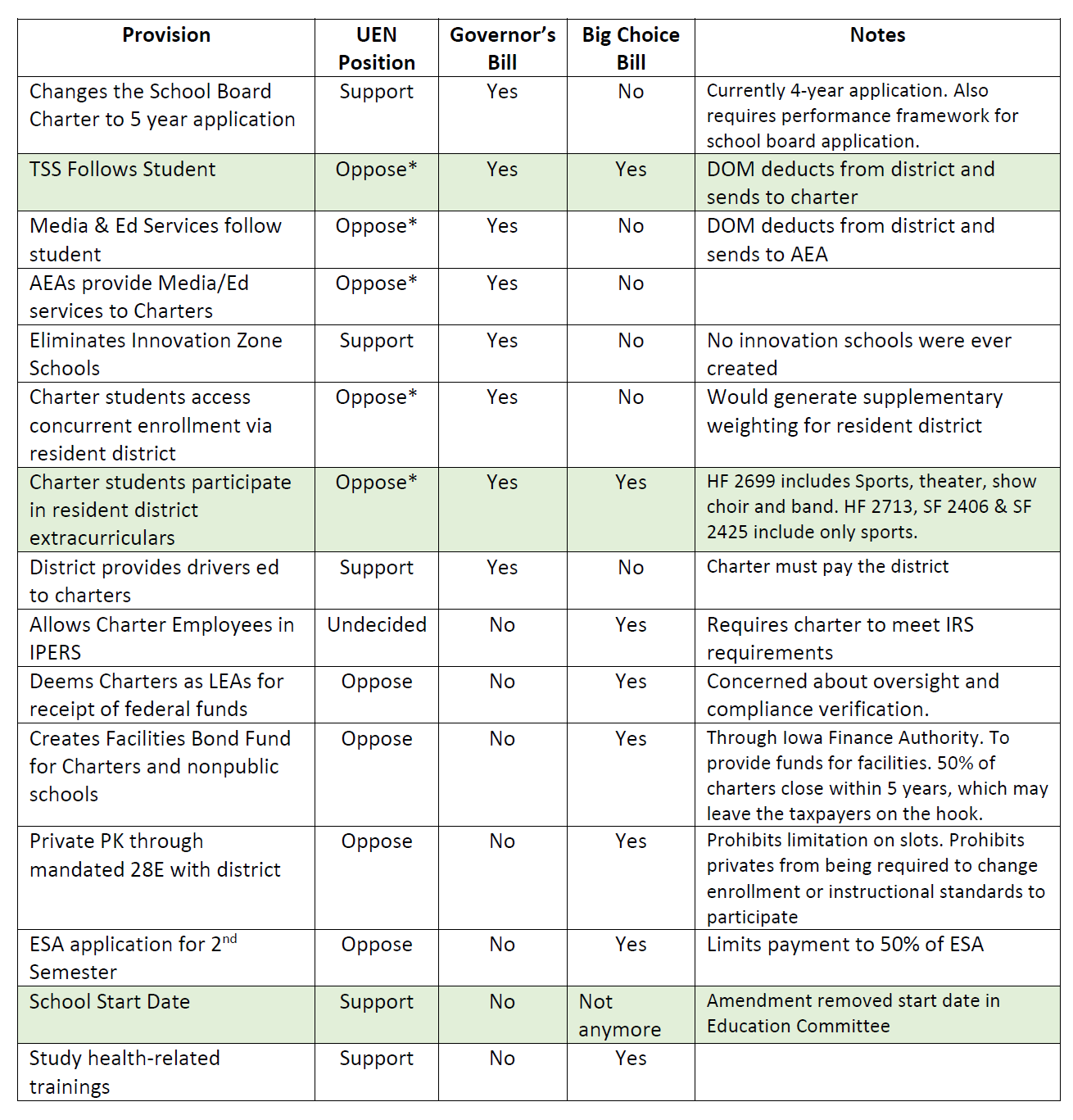
*UEN would not oppose these provisions if there was an appropriation for charter schools to fund them, rather than diverting funds from public school districts.
UEN Priorities Moving
- SF 2320 Concurrent Enrollment: superintendent or superintendent’s designee must sign off on a student wanting to enroll in an online concurrent enrollment course if the district offers the concurrent enrollment course in person. UEN Priority: Local Control. The bill was approved by the Senate, 44 to 0, sending it to the House Education Committee. UEN supports.
- SF 176 Limits on Extracurricular Participation for Students Open-enrolled into an Online Academy: Only allows participation in the extracurricular activity in the resident district if the attendance center offering the online program does not offer the activity. Requires payments to the district of residence, $250 per activity, for up to two activities per semester. UEN Priority: School Choice Limitations. UEN supports. The House amended and approved the bill, 94 to 2, sending it back to the Senate.
- HF 2684 ESA Categorical Flexibility: allows the school board to expend funds generated by resident students attending a private school with and Education Savings Account for any general fund purpose. UEN requested this bill. UEN Priority: School Choice and Local Control. UEN supports. The House approved the bill, 96 to 0, sending it to the Senate Education Committee.
- HF 2724 Alternative Endorsements for Shortage Positions: requires the BOEE to develop alternative endorsements for Fine Arts, Math, and Science teachers, for K-12 Strat II teachers without a master’s degree, and for a new activity’s administration authorization. UEN Priority: staff shortages. UEN supports. The House approved the bill, 94 to 2, sending it to the Senate Education Committee.
Bills to the Governor
- HF 2231 Civics Excellence Seals on Transcripts: Participation by districts is voluntary. Approved by the Senate 45 to 0, by the House 95 to 0, sending it to the Governor. UEN supports.
- HF 2610 Career and Technical Community College Updates: Aligns Iowa CTE code with federal requirements, requires common course numbering systems, and requires community colleges to implement a statewide corequisite model in Iowa community colleges. The House passed the bill 95 to 0. The Senate agreed 45 to 0. UEN is undecided.
Other Post-Funnel Floor Work (spot the unfunded mandates still moving): Bills surviving the first funnel must be approved in their chamber of origin, sent across the rotunda to the other chamber, and be approved by a committee in that chamber to survive the next funnel deadline, which is March 20th. These bills have been approved by the chamber of origin (and some are in the second bounce, already surviving the funnel):
- SF 2220 TAG and Advanced Pathways – DE’s bill requiring local talented and gifted programs and policies and requiring that districts automatically enroll students above proficient in math and ELA per state tests (and students proficient on local assessments) into the next more advanced course available, in the year immediately following the availability of test scores. UEN is concerned about the timeline of implementation (requested beginning advanced pathways no later than July 1, 2027) and challenges created by automatic enrollment. Unfunded mandates include additional staff, assessments to determine gaps in learning from skipping ahead, transportation costs if the next class is in a different building, challenges with schedule adjustments and staffing and credentialing requirements for teachers. UEN supports the TAG requirements and has concerns about the advanced pathways. The bill was approved by the Senate, 44 to 0, and is now in the House Education Committee. Unfunded mandate.
- SF 2319 Your Life Iowa Posting: requires schools to post a link to the Your Life Iowa website on district/school websites. Approved by the Senate, 44 to 0, sending it to the House Education Committee. UEN supports.
- SF 2335 School Technology Impact study: Requires DE, in collaboration with the HHS, to convene a working group to examine research related to the impact of school-provided technology on the cognitive function and academic performance of students. The membership of the working group is required to include, but not be limited to educators, mental health professionals, and parents of school-age children. The bill requires the working group to provide a report to the general assembly by December 31, 2026, detailing the working group’s findings and recommendations. The report must include recommendations on best practices related to the use of school-provided technology in educational contexts. Approved by the Senate, 45 to 0, and assigned to the House Education Committee. UEN supports.
- SF 274 Cash for Sports Tickets (back to Senate w/amendment): Requires districts to accept cash for tickets at sports events. Amended and approved by the House, 83 to 13, sending it back to the Senate. UEN is opposed. Unfunded mandate.
- HF 2244 US Government Requirements: Requires one unit of US Government and Civics for graduation (does not increase the social studies graduation requirements, currently at 3 units). First begins July 1, 2028. Also requires the equivalent of one-half unit of instruction related to civics and US government, or the equivalent, during grade seven or grade eight. For purposes of this subparagraph, a unit of credit consists of a course or equivalent related components or partial units taught throughout the academic year. Schools may need to hire additional teachers with the right credentials, plan for and purchase aligned materials with the expanded content, and provide training and time for lesson planning for teachers. UEN is undecided. Unfunded mandate.
- HF 2336 Student Protected Speech: Requires DE to annually post on their website and distribute, both electronically and by regular mail, the most recent version of the US DOE guidance related to constitutionally protected prayer and religious expression in public elementary and secondary schools to listed school staff. Requires DE to develop and distribute to school districts and charter schools, professional development training program regarding constitutionally protected prayer and religious expression in public elementary and secondary schools. Requires DE to develop a model policy compliant with federal student free speech guidance. Requires school districts to notify each employee of the DOE Guidance, provide PD opportunities to each employee, and enact a local board policy in compliance with the guidance. Allows for enforcement via civil suits. Approved by the House 63 to 33. UEN is opposed. Unfunded mandate.
- HF 2363 EL Open Enrollment: Requires a receiving district to offer an English Learner program if accepting an EL open enrollment request. Allows for transportation costs of an EL student to a nonpublic school be included as allowable expenses for EL supplementary weighting. Requires the district of residence to reimburse the receiving district for costs in excess of the weighting. Approved by the House 89 to 1, sending it to the Senate Education Committee. UEN is undecided.
- HF 2492 CTE Teacher Operational Sharing: Adds career and technical education teachers as a position qualifying for operational sharing supplementary weighting. UEN is undecided.
- HF 2494 DE Annual Reports on Literacy and Math Progress and AEA Services: Requires DE to submit annual reports on progress of these state initiatives and AEA services. Approved 95 to 1, and now in the Senate Education Committee. UEN is undecided.
- HF 2510 Social Studies Curriculum: Includes very prescriptive and specific mandated content and curriculum for social studies in the Iowa Code. You just have to read the bill to see the extent of the mandate. Prohibits the DE and State Board of Education from enforcing the existing “draft” social studies standards already approved by the state BOE. Prohibits use of the draft standards for any instructional, curricular, assessment, accreditation, licensing, certification, PD or evaluative purpose. School districts will have to analyze the legislative content compared to existing standards, curriculum, materials, assessment, and lesson plans, requiring significant staff time and resources to purchase compliant content. Approved 60 to 36, sending it to the Senate Education Committee. UEN is opposed. Unfunded Mandate.
- HF 2546 Electronic Education Data Reporting System: requires DE to procure a statewide education data reporting system to facilitate data collection between the student information systems of all school districts, accredited nonpublic schools, and AEAs. Requires modernization of statewide data reporting systems for the purpose of proper disbursement of moneys in a timely manner by increasing the ease and frequency of reporting submissions and collections throughout the school year and to ensure the DE’s systems are able to communicate with other state agencies, and with school districts, accredited nonpublic schools, charter schools, and innovation zone schools, to better identify needs for students. Requires DE to deploy a portal by July 1, 2027. Requires the portal to accomplish the following: Allows school districts, accredited nonpublic schools, charter schools, and innovation zone schools to (1) Validate the prior submission of data to the DE, (2) Perform a cross-district enrollment check prior to the submission of information, (3) Embed the communication tools between the DE and other school districts, accredited nonpublic schools, charter schools, and innovation zone schools. Requires the DE to provide access to a data dictionary that updates automatically, includes a calendar with key dates, is hosted by the developer of the software to reduce the burden on the DE associated with maintaining the portal and collects and distributes only the data required under federal and state law and the minimum amount of data necessary to enroll and serve new students from another school or educational institution. Requires data security and specifies that the data belongs to school districts. Approved by the House, 89 to 1, and is now in the Senate Education Committee. UEN is undecided.
- HF 2591 Open Enroll Wait Period for Extracurriculars: Changes the existing 90-school-day wait period before open-enrolled students may engage in varsity athletics in the receiving district, to 140 calendar days. Approved by the House, 90 to 0, and moves to the Senate Education Committee. UEN is undecided.
- HF 2649 Community College 4-year Degree Pilot Project: Requires DE to develop and administer the pilot project. Defines areas of limited access by distance from a regent’s university, limits BA programs to specific areas of labor shortage (includes education), and limits tuition to no more than 150% of the lowest regent’s university tuition. Approved by the House 56 to 36 and now in the Senate Education Committee. UEN supports.
- HF 2652 Play-based Learning PK-K: requires schools to provide 90 minutes of play-based learning for preschool students for each half day of program, and requires schools to provide 180 minutes of play-based learning for a full day program. Although philosophically supportive, UEN is concerned particularly about kindergarten, with challenging educational standards, materials, curriculum and lesson plans based on a more traditional model currently in place, that kindergarten teachers will need additional support, professional development and instructional models in order to implement with fidelity. We are also concerned that excluding PE from the play-based time period will further complicate the ability to meet instructional standards. We would prefer a longer on-ramp to accommodate these significant changes. Approved by the House 90 to 2. UEN is registered in support, but is still striving to improve the bill. Unfunded Mandate.
- HF 2676 MAHA Lunch and Physical Activity Requirements: this bill prohibits food dyes and preservatives, and sets other nutrition standards. Mandates district compliance with these standards by the school year beginning July 1, 2027. Requires nutritional content taught in health and other classes. Requires 30 minutes of physical education daily for students in grades K-5 and grades 6-8. Requires an additional 120 minutes per week of physical activity, in addition to the Physical Education requirement. For Grades 9-12 are required participate in 1 extracurricular or co-curricular activity in order to graduate, and the bill requires a contract for the student to document understanding of participation requirements. The bill was amended and approved 65 to 30 in the House. It is attached to SF 2367 on the Senate Calendar. UEN opposes the bill. Unfunded mandate.
- HF 2705 Flexibility and Deregulation for School Boards: Streamlines process to fill vacant board positions, provides authority for board members to review curriculum materials in a school library, provides that a school district shall not prohibit a board member from observing classrooms with reasonable notice, and shall not prohibit a board member from reviewing PD materials, authorizes use of electronic signatures and electronics contracts for hiring support personnel, streamlines the paid bills list that is published after the board meeting, regulates the publication of employee salaries, modifies duties of the SIAC, allows transfer of TSS to flexibility accounts, directs district effected by reorganization to use SAVE to first pay principal and interest and premiums on outstanding bonds. Includes restrictions on open enrollment if a student is engaged in chronic absenteeism requirements, and changes requirements for school district representations on conference boards. Approved by the House 96 to 0, and now assigned to the Senate Education Committee. UEN supports.
- SSB 3001 Senate Republican Property Tax Overhaul: The subcommittee moved the bill forward to the full Ways & Means Committee this week. UEN shared concerns about the significant cost to the state and the mismatch between reduced levy rates that happen up front and 12-year phase out of rollbacks. UEN supports the study of management fund authority but members are critical of implementing a threshold policy before receiving recommendations from the SBRC subsequent to the study. UEN appreciates the delay of implementation for many of the provisions impacting schools until July 1, 2027 or later. UEN is registered as undecided on the bill, primarily since the impact on local governments and taxpayers due to simultaneous changes to property tax rates, valuations and levy limitations are unknown. The provisions of SSB 3001 follow below.
Senate’s Property Tax Relief Proposal SSB 3001 Summary
- Division III: School Property Taxes July 1, 2027
- Sets regular program foundation base at 100% and sets special education support services foundation base at 100%. These two actions lower additional levy property taxes.
- Adds media and education services to the combined district cost
- Lowers uniform levy to $4.48662
- Sets reorg incentive uniform levies for years 1-3 at $3.66, $4.07, and $4.28. Returns to $4.48662 in year 4 following the reorganization.
- Transfers an amount sufficient to pay for the increase in the regular program foundation base to 100% from the SAVE to the state’s General Fund (page 21, line 23). This amount will decrease each year as the rollbacks are gradually eliminated and the uniform levy generates more revenue.
- Transfers ending balances of property tax equity & relief fund (from SAVE), property tax adjustment general fund appropriation ($24 million), and property tax replacement payments (state general fund appropriation) to where they came from June 30, 2026.
- Management Fund: Requires districts to report to SBRC all FY 2026 unexpended fund balances that exceed FY 2026 expenditures by 11/15/26. Requires SBRC to evaluate balances and expenditures and to consult with school boards and other experts to determine the appropriateness of establishing unexpended fund balance limitations for the management fund. The SBRC is required to make recommendations to the General Assembly by February 1, 2027, for fiscal years beginning on and after July 1, 2029.
- Phase-In Schedule for Maximum Management Fund Balances: Starts at 180% of the average of prior three years' expenditures in FY 2029 and gradually drops to 160% in FY 2033.
- Division IV Rollbacks & Levy Rates:
- Phases out residential rollback over 12 years.
- Phases out commercial rollback effective for valuations for the 1/1/26 assessment year. First $150K of commercial value receives the 12-year residential rollback benefit each year.
- Limits total PPEL to $1.18 (Board PPEL at 24 cents and VPPEL at 94 cents).
- Limits bond levies to $1.89 and $2.84 (does not apply to bonds issued for elections held on or before November 4, 2025, and sold on or after May 2026).
- Sets voted levies at 70% of the prior rate limits.
- Allows school boards, by resolution, to set a higher limit if necessary to make bond payments.
- Division V: Homestead and Other Credits and Exemptions
- Homeowners over 60 years old with no mortgage are exempt from paying property taxes, phased in over four years, beginning in the assessment year January 1, 2026, through January 1, 2029, eventually at 100% of valuation.
- Phases in the homestead credit, which starts at 25% of the value not to exceed $175,000, beginning with the assessment year, January 1, 2026. Gradually increases to 50% of the value through the assessment year beginning January 1, 2036, not to exceed $350,000. (Current homestead exemption is $4,850 for all residential property taxpayers.)
- Several other smaller exemptions and credits are expanded.
See the ISFIS Side-by-Side Comparison of the three Property Tax Proposals for your reference in reaching out to legislators this coming week. As the Session is now past the first funnel deadline and getting closer to adjournment, expect work on Ways and Means and Appropriations bills to continue in earnest.
Advocacy Actions This Week
Property Tax Reform: Contact legislators regarding property tax reform. Ask them how the conversation is going. What questions do they have?
The Governor’s version is more modest than the Senate’s, but still accelerates SAVE funds within a very short time frame, negatively impacting resources available for school infrastructure, safety and equipment. This proposal removes an estimated $200 million annually from school infrastructure, technology, safety, equipment, buses and construction in four years. Reach out to the experts at Piper Sandler to discuss the point at which your district may be at risk of defaulting on bonds if SAVE is reduced based on the Governor’s proposal. See Piper Sandler’s SAVE Bond Default Risk Calculator
Talking Points:
- Property Tax Relief or Reform? Encourage legislators to get fiscal estimates before proceeding with big system changes. The impact of multiple changes to all three components of the system is very hard to predict. If reform reduces revenue, it is property tax relief.
- Much of the Governor’s version spares schools. One concern is the acceleration of SAVE funds to property tax relief, negatively impacting resources available for school infrastructure, safety and equipment ($200 million off the table in 4 years). Many districts are bonded against the SAVE, so they may be put into a default situation. A reduction in SAVE would require schools to turn increasingly to bond issues and ask voters to raise PPEL rates. If voters don’t approve, districts will have to reduce SAVE currently used for safety, technology, updated buses and equipment. Noninstructional software and buses are expensive. If they are to be paid from the general fund, schools will have to further reduce staff or delay upgrades.
- Policies do not change in isolation. Low SSA and declining enrollment, with the State taking over budget guarantee, should already lower school property tax burdens for taxpayers.
See the UEN Property Tax Reform 2026 Issue Brief for additional talking points and items to discuss with your legislators. See the ISFIS Property Tax Comparison Side-by-Side, which compares and contrasts the ideas in all three.
SSA and Unfunded Mandates: Now that SSA is done, ask legislators to resist every unfunded mandate that has moved forward through a committee. Unfunded mandates increase the need for administrative time and energy, pulling instructional leaders away from supporting teachers with literacy and math plan implementation and helping with behavior issues. Also, ask them to carefully consider enactment dates of mandates and policies that do move forward, so schools have enough time to await state BOE rules and DE guidance, develop local policies, train staff and align or correct current curriculum, standards and lesson plans.
Thank legislators for the bills moving forward that UEN supports!
Connecting with Legislators: To call and leave a message at the Statehouse during the legislative session, the House switchboard operator number is 515.281.3221 and the Senate switchboard operator number is 515.281.3371. You can ask if they are available or leave a message for them to call you back. You can also ask them for the best way to contact them during the session. They may prefer email, text message, or a phone call, based on their personal preferences.
Find out who your legislators are through the interactive map or address search posted on the Legislative Website here: https://www.legis.iowa.gov/legislators/find
Other UEN Advocacy Resources:
Check out the UEN Website at www.uen-ia.org to find Issue Briefs, these UEN Weekly Update Reports and Videos, UEN Calls to Action when immediate advocacy action is required, testimony presented to the State Board of Education, the DE or any legislative committee or public hearing, and links to fiscal information that may inform your work. The latest legislative actions from the Statehouse will be posted at: www.uen-ia.org/blogs-list. The 2026 UEN Advocacy Handbook will be available and posted soon at www.uen-ia.org/advocacy-handbook.
Contact Us
Margaret Buckton
UEN Executive Director
margaret@iowaschoolfinance.com
515.201.3755 Cell
Thanks to our 2025-26 UEN Corporate Sponsors:
Special thank you to your UEN Corporate Sponsors for their support of UEN programs and services. Find information about how these organizations may help your district on the Corporate Sponsor page of the UEN website at www.uen-ia.org/uen-sponsors.
- 10Fold Architecture + Engineering - www.10foldarchitecture.com
- INVISION Architecture - www.invisionarch.com
- Solution Tree - www.solutiontree.com/st-states/iowa