Capitol Update - April 23, 2026
UEN Legislative Update
April 23, 2026
(Download this week's printable UEN Legislative Written Report)
This UEN Weekly Report from the 2026 Legislative Session includes:
- How Long is this Session Going to Last?
- Budget Progress in the Chambers (including Education Appropriations)
- Bills to the Governor
- Bouncing Bills (amended back and forth between chambers) and including SF 2472 Property Taxes
- Civics Test Resources on DE’s Website
- Advocacy Actions for the Week
- Advocacy Resources
How Long Is This Session Going to Last?
The Session has extended beyond April 21, when per diem reimbursements for Legislators expired. Before adjourning, the House and Senate will have to pass a budget (appropriations bills), decide whether to compromise on property tax reform, and determine whether there is common ground on other policy bills awaiting their attention. We expect a bit of overtime given the remaining items on their agenda.
In the Tuesday, April 21st Iowa Capital Dispatch, leadership anticipated more work, but expected resolution of their differences soon:
- “We’re making a lot of progress on budgets, a lot of progress on property taxes and a lot of progress on the final policy bills,” House Majority Leader Kaufmann said. “So I would anticipate a full week of work, and I think the momentum’s on our side to be shutting down — I’m not going to put a date onto it — but ASAP.”
- Lawmakers officially adjourn, or sign the “sine die” resolution, after passing bills funding the state government for the next fiscal year.
- House Speaker Pat Grassley told reporters that negotiations on spending are currently underway in the areas that make up the total $40 million difference between House and Senate Republicans’ budget targets for fiscal year 2027.
- “We do not have necessarily an overall budget target agreement with the Senate and the governor, but what you’re seeing in our line items is where the House is at, at this point,” Grassley said. “We recognize there’s probably middle ground to be found with the Senate and with the governor.”
- “Negotiations (on property taxes) are ongoing, discussions are ongoing, and I still feel confident that we’ll get something done this year,” House Ways and Means Chair Nordman said.
Consensus on Property Tax Reform may be more difficult than the budget, given some very different approaches to the issue. The article quoted Sen Dan Dawon, Senate Ways and Means Chair, in his point of personal privilege regarding a bill mandating more city and county pay for public safety IPERS retirement costs:
- Sen. Dan Dawson, R-Council Bluffs, who has led the discussions on property tax legislation in the Senate, spoke on the Senate floor about the need for lawmakers to think about the larger picture of property taxes, bringing up House File 1023, a bill passed by the Senate unanimously Tuesday related to Iowa Public Employees’ Retirement System employee contribution rates (for public safety employees). Dawson said the measure was “a good piece of legislation.”
- “But it is also a property tax increase,” Dawson said. “And it is also an unfunded mandate to local government. You cannot take an unfunded mandate to local government, and on the same pieces of proposed legislation in this general assembly, say ‘we are going to hard cap property taxes here in this state.’ Policy matters and thought process matters in this building. And I hope, as we move into the 100th day and beyond, to close this deal on property taxes, the entire general assembly — this entire building — thinks about what we are proposing, what we are passing, what we are signing into law, and how this works for Iowans.”
By Thursday, April 23, even more progress was announced on the budget. The IALNS Reported:
“Senate Republicans did release their revised budget targets for the Session and offered a comparison with the House. The Senate increased its budget targets by about $20 million and is now about $3 million below the House.
- Administration & Regulation - $73,301,113 (House $73,331,113 -$30,000)
- Agriculture & Natural Resources - $47,505,670 (House $47,261,670 +$244,000)
- Economic Development - $39,948,145 (House $39,348,145 -$400,00)
- Education - $1,042,048,417 (House $1,406,657,903 -4.609 million)
- Health & Human Services -$2,560,094,417 (House -$2,560,438,417 +344,000)
- Justice Systems - $938,006,002 (House $936,539,672 +$1.46 million)”
Although the Senate targets have now been released, there is much work to do in amending the Senate Appropriations bills, which, for now, are the Governor’s budget recommendations. Once the Education Appropriations bill in the Senate is released, we will report on its differences with the House. That budget has the largest disagreement between the two targets, with the Senate at $-4.609 million below the House.
Action on State Budget
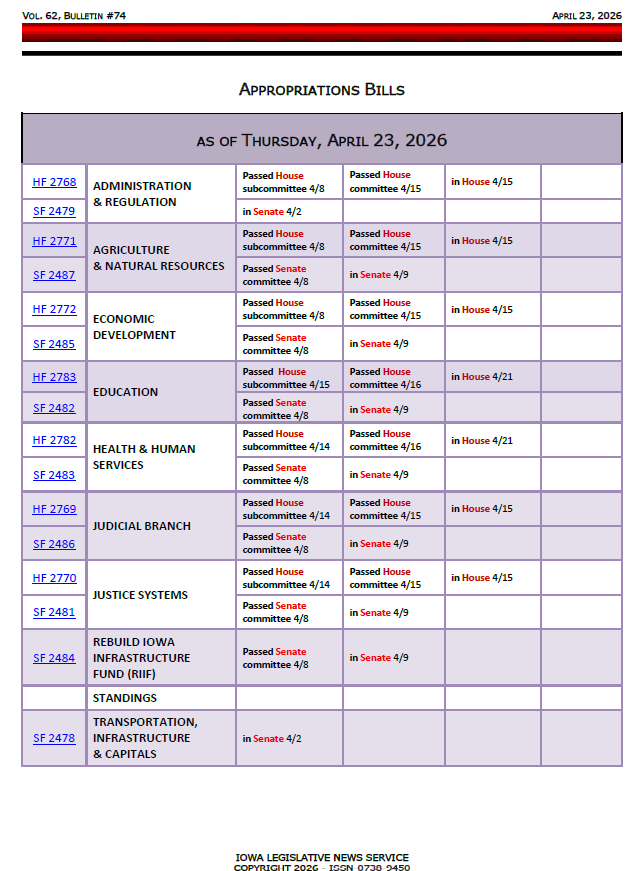
This chart from the IALNS Newsletter below, through April 23, shows progress on budget bills, with many awaiting debate calendars for amendments to compromise or consensus. One of those is the Education Appropriations bill, HF 2783, on the House Calendar (with companion SF 2482 the Governor’s Recommendation on the Senate Calendar).
Most of the appropriations in this Bill echo the Governor’s Recommendation for FY 2027. The House makes the following changes (but areas of concern from the Governor’s recommendation repeated by the House are also noted).
- An increase of $92,646 for TeachIowa Scholar Grants (above the Governor’s Recommendation).
- A new appropriation of $3 million to the U of I for pediatric cancer research.
- Includes an increase of $5 million for DE Division of Special Education. This would bring the total to $10 million, all from the state general fund. Last year, $5 million was appropriated from the General Fund and $5 million from the Sports Wagering Fund.
- Postpones the $10 million appropriation for High Needs Schools Grants until the year beginning July 1, 2027. This appropriation has been delayed every year since its inception in Gov. Branstad’s Education Reform Action, first effective in FY 2014-25.
- Includes the individual allocations for several items funded with the Student Achievement Teacher Quality Act, including the Iowa Teacher of the Year (Ambassador for Education), professional development academies, model evidence for TLC plan and evaluation, and the fine arts beginning teacher mentoring program). These allocations were not included in the Governor’s Education Appropriations Bill.
- The Bill also included language regarding dropout prevention board plan approval, clarifying that school boards are required to approve the plan annually, and prohibiting SBRC and DE from deducting spending authority due to a lack of annual board approval until July 1, 2027. The Amendment in the Appropriations Committee removed the retroactive date, including SBRC and DE action, but retained the language clarifying that the plans must be approved annually. UEN requested this provision and is disappointed that the Appropriations Committee removed it.
The Bill is on the House Debate Calendar. UEN is registered undecided.
Bills to the Governor
The Enrolled bills list includes bills for which the House and Senate have completed action and the Governor’s signature is pending. Bills sent to the Governor during the Session require her signature or veto within 3 days. Bills sent to her in the final three days of the Session follow a different timeline, allowing the Governor 30 days to sign or veto. Here are the bills on the Enrolled Bills list posted on the legislative website as of April 22:
|
Bill Number |
Enrolled Bills |
|
Civics Seal |
|
|
CINA for MH or Substance Abuse |
|
|
Academic Fraud |
|
|
IPERS Share |
|
|
Election Responsibilities |
|
|
Childcare Workers CCA (Signed 4/9/26) |
|
|
Public Improvement Bidding (Signed 4/9/26) |
|
|
140 Days Eligibility period 8th grade Varsity |
|
|
CTE and Community Colleges DE bill |
|
|
Satellite Absentee Voting |
|
|
Online Academy extracurricular participation |
|
|
Grooming Definition |
|
|
Civil Rights Commissions (Signed 3/10/26) |
|
|
Elective Jr. Firefighter Program |
|
|
SSA 2% (Signed 2/23/26) |
|
|
School Activities Absence Exemption |
|
|
TAG, Accelerated Learning, Math/ELA pathways |
|
|
Concurrent enrollment Repayment (failure or drop) |
|
|
Concurrent Enrollment Modality in-Person |
Bills to the Governor This Week
SF 2220 Tag, Advanced Math Pathway and Grade Acceleration Bill
HF 2670 State Assessment, Financial Penalties for Noncompliance, and Education Provisions
SF 2231 Community-Based (Private) Preschool and Religious Exclusions
SF 2299 Community College Payback Costs
SF 2320 Concurrent Enrollment Modality
HF 2490 Public Meeting Notices and Personal Records
SF 274 Cash for Entry to School Athletic Events
SF 2430 Display of Flags at Half Staff on Public Buildings
SF 2220 DE’s TAG, Advanced Math Pathway and Acceleration Bill: Amended by H-5132 in the House, the Bill now includes the following provisions:
- State Testing: moves state science testing from 10th grade to 11th grade.
- Talented and Gifted Provisions:
- Talented and Gifted (TAG) identification: Requires school districts to establish systematic and uniform procedures for screening, referring, identifying, and serving TAG children, based on evidence from multiple data sources. Prohibits any one criterion from being used to deny TAG services to an otherwise qualified student.
- TAG Services: Requires school districts to provide education service options for TAG students in their area of giftedness. Requires school boards to make all reasonable efforts to provide educational services to each gifted and talented child that promotes the academic growth in the gifted and talented child’s academic strengths.
- School Board Policy: Requires school boards to annually review TAG students’ progress. Requires school board policy directing the program.
- Advanced Math Pathway:
- Requires school boards to develop an advanced mathematics pathway designed to increase the number of students completing higher-level math in grades 9-12. Establishes a goal for pathways to enable students to be prepared for and enroll in algebra as early as middle school and complete it no later than by the end of 9th grade. Requires school districts to automatically enroll a student in an advanced math pathway if certain conditions are met, unless parents opt out. Requires automatic enrollment in the next most rigorous course offered by the district for students who meet all of the following criteria:
- Attained a score within advanced performance level on a statewide math assessment in grades 5, 6, or 7.
- Demonstrated proficiency as indicated by math coursework or other local measures when enrolled in grades 5, 6, or 7.
- Defines “advanced math pathway” as a sequence of courses and curricula that accelerates or combines math instruction that is typically provided to students enrolled in grades 6-8.
- Requires school boards to develop an advanced mathematics pathway designed to increase the number of students completing higher-level math in grades 9-12. Establishes a goal for pathways to enable students to be prepared for and enroll in algebra as early as middle school and complete it no later than by the end of 9th grade. Requires school districts to automatically enroll a student in an advanced math pathway if certain conditions are met, unless parents opt out. Requires automatic enrollment in the next most rigorous course offered by the district for students who meet all of the following criteria:
- Subject and Whole Grade Acceleration:
- Requires school boards to establish and implement procedures for subject and whole-grade acceleration. Any student enrolled in grades 4-12 who meets the requirements, including but not limited to advanced performance levels on ISASP in math or English language arts, and is academically prepared shall be automatically enrolled in the next most rigorous level of advanced courses or programs offered by the school district in the next school year.
- Requires the school district to determine student academic preparedness using any of the following data sources: Standardized assessments, student achievement, cognitive ability, creative ability, qualitative and quantitative data, teacher and parent input, observation of gifted characteristics and behaviors, and the school district determines that the student is prepared to participate in the next most rigorous level of advanced courses or programs offered by the school district.
- Unfunded Mandates: Requires school districts to pay costs required by the Bill as amended from State Foundation School Aid per Iowa Code section 25B.2 (state mandates).
- Delayed Implementation: advanced math pathway, grade acceleration, and automatic enrollment in advanced courses apply to school years beginning on or after July 1, 2027.
The Bill was amended and approved by the House 84 to 11. The Senate concurred with the House amendment 44 to 3, sending it to the Governor. UEN is undecided but had requested and appreciates the delayed implementation and expanded district authority to determine student readiness for advancement.
HF 2670 Summative Testing, S-5113: The Bill, as amended, does the following:
- Adds social studies to the state’s core academic indicators and requires a summative social studies assessment as part of the Iowa Statewide Assessment of Student Progress (ISASP), administered to students in grades 8 and 11, to align with Iowa standards in both rigor and content. This provision is effective beginning on or after July 1, 2027.
- Moves summative science assessment administration from grade 10 to grade 11.
- Requires instruction related to physical education and food and nutrition in the health standards in all three grade spans (1-6, 7-8, 9-12).
- Allows for the two additional units of mathematics for students in grades 9 through 12 to include instruction related to agriculture and applied sciences (if the content meets the Iowa Code course requirements).
- Requires guidance counselors to work collaboratively with parents or guardians.
- Requires the State Board of Education (BOE) to impose financial penalties, including withholding of state aid in instances of noncompliance with relevant State and federal requirements if noncompliance is not cured within 30 days.
- Removes requirements for adopting administrative rules on protocols for identifying adverse childhood experiences (ACES), distributing standards for equity coordinators to school districts, adopting a multicultural and gender-fair approach, providing emotional and social health instruction, and considering standards and best practices from certain national organizations, as well as services provided by guidance counselors.
- States that any costs associated with the implementation of this Bill do not constitute an unfunded mandate, and requires school districts to pay costs required by the Bill as amended from State Foundation School Aid.
The Bill was amended and then approved, 30-17, sending it back to the House. UEN is registered in opposition, primarily to the financial penalty for state and federal noncompliance. Some federal noncompliance may take longer than 30 days to correct. We do appreciate the implementation deadline of July 1, 2027 for the new social studies tests.
SF 2231 Community-Based (Private) Preschool and Religious Exclusions
- Requires schools to allow community-based providers to participate in PK programs through a 28E agreement. Prohibits limits on the number of students who can enroll in the community-provider programs. Limits the authority to regulate the standards for admission or for programs as a condition of receiving aid. Deems that a community provider is not an agent for the state. Strikes language and removes exclusions based on religious content for aid for textbooks, tuition and child development.
- S 5177 by the House - Requires the DE to distribute federal guidance on constitutional protections on religious instruction.
- Includes other protections (Prohibits schools from preventing students from engaging in religious, ideological or political speech or from expressing such views in schoolwork. Requires schools to allow students to wear clothing and jewelry that expresses political and religious views and prohibits discriminating against student clubs for political or religious views.)
- Requires DE to distribute federal guidance on constitutional protections on religious instruction to superintendents electronically, for the sups to distribute it to principals and for schools to provide PD.
- Requires voluntary PK providers to comply with the same requirements as public schools. (UEN requested this provision.)
The House approved the Bill as amended 63-25. The Senate concurred 28-16, sending it to the Governor. UEN opposed the forced 28E agreement, though the amendment requiring private PK to meet the SVPP standards somewhat neutralizes our opposition.
SF 2299 Community College Payback Costs: Allows a superintendent (or designee) to require a student (or their parents) who fails a community college course or drops the course to reimburse the district for the cost. The House amended the Bill (to include repayment due to dropping the course) and passed it 62:31. The Senate concurred 33:12, sending it to the Governor. UEN supports.
SF 2320 Concurrent Enrollment Modality: if a community college offers a concurrent enrollment course using both instruction that is delivered in person and primarily over the internet, then the student must enroll in the in-person course unless the superintendent, or the superintendent’s designee, authorizes the student to enroll in the online course. Requires the superintendent (or designee) to consider if the student is prepared for, and likely to be successful in, the online course. Allows the superintendent (or designee) to consider any other factors they deem relevant, including but not limited to potential scheduling conflicts that may impact the student’s ability to participate in the in-person course. The Bill was approved by the Senate, 44:0, and by the House 91:2, sending it to the Governor. UEN supports.
Note: Just a reminder, current law requires the school board to annually approve courses to be made available for high school credit, using locally developed criteria that establish which courses will provide students with academic rigor and adequately prepare them for transition to a post-secondary institution. Current law also requires that if a community college accepts a student for enrollment under this section, the school district, in collaboration with the community college, shall send written notice to the student, the student’s parent or legal guardian in the case of a minor child, and the student’s school district. The notice shall list the course, the clock hours the student will attend, and the number of college credit hours the student will receive from the community college upon successful completion of the course. It would be important, but not required by law, to also include a notification that if the student fails the course, their parent (or the student, if an emancipated minor) may have to reimburse the school district for the cost.
HF 2490 Public Meeting Notices and Personal Records: Requires giving notice to news media who have requested it for public meetings, and for posting notices about open meetings in a conspicuous place and on a government website. Requires amended agendas to be marked as amended. The Bill was amended by the Senate, H 8389, which added text from HF 2638 Public Personal Records. The Bill deems some confidential information regarding an employee or contractor (considered personnel records) to be public records. Includes information on final day of work, reasons for leaving work and misconduct, and any benefits beyond pay (including moneys and public benefits provided to the individual for any continuation of pay, severance, or other compensation or benefits in excess of the amounts owed for work performed by the individual prior to their last day as an employee, contractor, or appointee for the government body, regardless of whether the information is contained in a written document, contract, agreement, or arrangement.) The Bill allows a government to seek an injunction against a person found to be a vexatious filer for open record requests. Defines vexatious requests and excludes the media. The Senate approved the Bill as amended 44-0, and the House concurred 89-0, sending it to the Governor. UEN is undecided.
SF 274 Cash for Entry to School Athletic Events: this Bill was amended by the Senate to exclude venues not owned by schools, allowing them to not accept cash (such as venues at universities or Wells Fargo Arena, typically used for regional and state tournaments). The Senate approved the Bill as amended, 44:0. The House concurred, 81:7, sending it to the Governor. UEN opposed.
SF 2430 Display of Flags at Half Staff on Public Buildings: requires local government and all other public buildings to present flags at half staff when ordered by the Governor. Provides for a citizen report to the Attorney General(AG) and allows the AG to require injunctive relief to garner compliance. Approved in the Senate, 38:9. The House agreed, 82:5, sending it to the Governor. UEN is undecided.
Bouncing Bills
HF 2676 MAHA (Make American Healthy Again), H-8355 Senate Strike-after Amendment to S-5302 Provisions of this Bill impacting schools include:
- Health Curriculum: Requires the kindergarten program, Elementary and Secondary standards to include instruction related to nutrition that emphasizes: (1) The importance of animal-based protein, dairy, vegetables, and fruit. (2) The nutritional benefits of animal-based protein, dairy, vegetables, and fruit. (3) The role that animal-based protein, dairy, vegetables, and fruit play in a balanced diet.
- Other Curriculum: Requires the agriculture, food, and natural resources career and technical program to include instruction relating to food production and the benefits of local sourcing.
- Food Dyes: Prohibits schools foods from containing certain dyes, effective July 1, 2027.
- Ephidrine Delivery Systems: Changes every reference in IC 280.16A from Epinephrine auto-injector (Epi Pen) to Epinepherine delivery system. (School boards will need to update policies accordingly.)
- Instructional Technology Time Limits K-5
- Sets instructional technology time limits in elementary classrooms: 60 minutes per day maximum for grades K-5, but specifies the following exceptions:
- IEP/504 requirements for technology
- Assistive or adaptive technology to student access to instruction or to accommodate differing student abilities (for e.g., EL, TAG, or other)
- Teacher-directed instruction (projector, smartboard or similar display device when students are not individually operating a device
- State assessments, screening, progress monitoring and local diagnostic assessments
- Dedicated computer science and technology curriculum.
- Requires school boards to have policies regulating instructional technology minutes as required by the Bill, including the district’s daily digital instruction limits, notice of a parent’s or guardian’s right to request additional reductions in their child’s digital instruction, a statement that instructional technology shall support, and not supplant, foundational learning and a prohibition on the use of digital devices during recess. Requires the district to publish the policy on each elementary school’s internet site.
- Requires school districts to complete a technology adoption checklist prior to adopting or renewing a one-to-one digital device program for any grade level. Requires the school board to complete a technology adoption checklist that documents consideration of all of the following: (1) The instructional purpose of the device. (2) Age appropriateness of the device and associated software. (3) Content-filtering limitations and the district’s capacity to mitigate those limitations (4) Whether student data is collected, stored, or shared, and the nature of such data practices. Requires the school board to retain the checklist and make it available to the DE upon request for audit or compliance purposes.
- Requires each school district to post on the district’s internet site a list of one-to-one digital device programs in use, and information regarding opt-out options for parents who decline participation in digital instruction.
- Specifies that the technology limits to not apply to students enrolled in an online learning program.
- Sets instructional technology time limits in elementary classrooms: 60 minutes per day maximum for grades K-5, but specifies the following exceptions:
- Physical Activity and PE Requirements
- Requires Physical Activity minimum minutes in elementary classrooms, of 40 minutes in K-4 (current law is 30 minutes) and retains 30-minute minimum in 5th grade (no change).
- Requires PE to include physical activity/leisure activity and nutrition content.
- Requires school districts to administer the Presidential Physical Fitness Test to all students who are physically able. Takes effect upon the issuance of final guidance for the administration of the presidential physical fitness test by the federal government. Requires the DE to inform the Iowa Code editor upon the issuance of final guidance for the administration of the presidential physical fitness test by the federal government.
HF 2676 originally passed the House, 65:30, was amended and passed the Senate 30:15, then was amended by and passed the House 61:31. Back to the Senate. UEN was registered opposed to the PE unfunded mandates in an earlier version of the Bill and the limited number of instructional technology exceptions. Thanks to all advocates who responded to the MAHA Call to Action and contacted your legislators. With changes in the last two amendment iterations, UEN registration will change to undecided.
SF 2428 Student Behavior: House Amendment was amended by the Senate and sent back to the House. H-8399 removed the requirement that every teacher read and sign a confirmation of reading for every IEP. Instead, requires each school district employee responsible for implementing a student’s IEP, including regular education teachers, special education teachers, and any other service providers, to read all changes to accommodations or modifications described in the IEP. Requires the regular education teacher to confirm that they have read the recent changes to the special education teacher. Note: the Senate did NOT insist on their original review committee having to decide when a student returns to the classroom, which the House amendment removed. The Bill was amended and approved by the Senate, 44:0, and goes back to the House. Thank you to all advocates who responded to the Call to Action on Student Behavior, particularly those who opposed the review committee, which was removed in the House amendment. The Senate further removed the IEP reading mandate, 44:0. The Bill is back to the House. UEN is undecided and appreciates the continued progress made along the way. See the April 9th UEN Weekly Report for a detailed bill description.
HF 2754 Charter Schools: House amendment added homeschool expansion provisions. A Fiscal Note for the Bill was published, indicating the fiscal impact on school districts of the TSS and other funding provisions. The fiscal note stated:
- As reported in the Dec. 2025 DE Iowa Charter School Legislative Report, 16 charter schools are currently authorized to operate in Iowa of which 10 are operational in the 2025-2026 school year.
- Based on the fall 2025 charter school enrollment, there are 1,382 students from 107 resident districts attending charter schools.
- The Iowa Coalition for Public Charter Schools projects 1,945 charter pupils in FY 2027.
- A pupil attending a charter school using the school district model will continue to be counted as a pupil of the public school district, and school aid funding will not be affected.
- For FY 2027, the TSS will be paid to the charter schools for FY 2027 enrollment and to the public school districts for FY 2026 enrollment due to the current mechanics of payment of school aid. Division I appropriates an estimated $1.3 million for the TSS payment to charter schools for FY 2027.
- School districts will be reimbursed for Drivers Education costs as required in the Bill.
The House amendment added new homeschool provisions, minimizing existing law limitations on homeschool:
- Removes the limitation of no more than 4 unrelated children in a homeschool.
- Allows homeschools to charge fees and tuition
- Requires by state law that homeschool diplomas be recognized on par with high school diplomas for purposes of post-secondary or training access, any credential, employment, state or local programs or benefits, or any other purpose under the laws of this state in which a high school diploma is a condition or a qualification. This provision is retroactively applicable (to any diploma ever awarded by a homeschool parent/teacher).
- Specifies that a homeschool graduate cannot be required to get GED or other alternative credential.
UEN was opposed to the original Bill, for many reasons, but primarily due to TSS shift to follow charter school students. The additional homeschool freedoms only add to our opposition. The Bill was amended by the House, sent to the Senate, where it is attached to SF 2501 on the Senate Calendar.
HF 2764 School Budget Assumptions: This new Bill just moved through House committees and was approved on the House floor. The Bill specifies that, if SSA is not determined by March 5, school district must base the first budget (created for taxpayer notices and public hearing #1) on an assumption no higher than the prior year’s SSA percent of growth. The Bill further allows property taxes set for the second public hearing, budget consideration by the school board, to exceed the property taxes set for the first public hearing, due to timing of enrollment determination and enactment of legislation affecting budgets during the budget process (subject to other limitations in law, i.e.. PPEL rate limits and voted rate limitations would still apply.) UEN supports this Bill. It was approved in the House, 91:1, sending it to the Senate. It is assigned to the Senate Ways and Means Committee.
HSB 781 School Cash Reserve Levy: Allows a school district to increase its cash reserve levy in excess of Code limits if the district has one property that was devalued by at least $100 million in the 2025-26 school year and the district decreases other levies in a corresponding amount. In the House Ways and Means Committee with Reps. Young, Gustoff, and Judge assigned. UEN supports.
Conference Committee SF 2218 Legality of Working in the US: Requires verification of the identity and employment eligibility of individuals by the board of educational examiners, school districts, accredited nonpublic schools, charter schools, and innovation zone schools. The House had amended the Bill with S-5104 with another division prohibiting private employers from hiring individuals who cannot legally work in the country. The Senate refused to concur with the House amendment. The House insisted. A Conference Committee of 5 legislators from each chamber has been appointed to resolve their differences. They have scheduled and canceled several meetings in the last week. UEN is undecided.
SF 2472 Property Taxes
The House replaced SF 2472 with their own, via S-5210 Amendment. The House proposal does the following: first, provisions impacting primarily cities and counties; then, provisions impacting school districts.
Provisions Impacting Primarily Cities and Counties
- Sets a 2% “hard” cap on local government’s revenue growth (cities and counties, not schools). (Senate has a “soft” cap responsive to inflation, increases gas tax and allows an increase LOSS for cities and counties to recover some capacity.)
- Converts the existing homestead tax credit to an exemption while tripling its amount of exemptible tax value to $15,000. (Senate changes rollbacks, phases in homestead exemption up to 15% of value, not to exceed $150,000 and creates a new elderly property tax credit aligned with age - 100% exemption at age 100.)
- Limits new Tax Increment Financing (TIF) districts to periods of 23 years and removes the School Aid Foundation and Emergency Medical Services levies from TIF diversion (saves the state cost of uniform levy). (Senate limits all TIF to 20 years, exempts uniform levy and creates a TIF taskforce.)
- Reforms taxpayer statements (input from cities and counties) effective for budgets beginning 7.1.27), and allows online posting. (Senate only allows online posting.)
- Creates a $10 million grant to help local governments pursue consolidation and shared service agreements, and creates FirstHome Iowa Accounts based on the Iowa 529 Plan.
Provisions impacting schools include:
- Lowers the $5.40 uniform levy to $5 (changes reorganization incentive tax relief accordingly). Both provisions are effective 7.1.27.
- Extends SAVE to Jan. 1, 2071 (this is intended to allow districts unable to make bond payments against SAVE, given the next provision, to be able to refinance the bonds).
- Accelerates SAVE contribution to property tax relief (buys down the additional levy to the average then buys down the $5.40 levy): The percentage of SAVE diverted annually for property tax relief follows: 12.5% FY27. 15% FY28. 17.5% FY29. 22.5% FY30. 25% FY31 and beyond. (Senate has no SAVE provisions. The Governor’s proposal had a shorter implementation schedule and diverted 30% of SAVE to property tax relief.) Requires DOM to reconcile SAVE in the fiscal year immediately following the fiscal year when the revenues were received.
- Allows schools to pay funds to cities to support TIF (but prohibits asking SBRC for corresponding authority).
- Adds a June special election date option for bond elections.
- Limits school district UAB (Unspent authorized budget, or spending authority) to no more than 35% of authorized expenditures (effective July 1, 2026). Makes a district’s on-time modified supplemental amount (MSA) request permissive for SBRC approval. Requires school boards to have a financial policy establishing a targeted range and maximum UAB, reviewed annually. We are opposed to the UAB limitation but support the requirement that a local school board have a financial policy with a UAB-targeted range and a maximum goal.
Was amended and passed by the House, 64:23. Heads back to the Senate Calendar. UEN is undecided.
Civics Test Resources on the DE Website
The DE has posted information and resources on their social studies webpage found here: https://educate.iowa.gov/pk-12/standards/instruction/social-studies#civics-test
Senate File 369 approved in the 2025 Session directed DE to develop a multiple-choice test that consists of all questions contained in the most recent version of the civics test developed by the United States Citizenship and Immigration Services, and to distribute the multiple-choice test to school districts, accredited nonpublic schools, and charter schools.
- The statute establishes a requirement for the board of directors of a school district or authorities in charge of an accredited nonpublic school to administer the civics test developed and distributed by the DE to students in grades 9-12. The school district or accredited nonpublic school shall ensure that each student receives one passing score as a condition of graduation.
- A school district or accredited nonpublic school is to report the results of the test to the DE by June 30 of each year.
SF 369 Civics Test Information and FAQs (164.04 KB).pdf
SF 369 High School Civics Test (207.73 KB).pdf
Make a copy of the SF 369 High School Civics Test as a Google Form - Note: The "make a copy" function will require the user to sign in to their Google account, since the file is saved to Google Drive, which requires a Google account.
SF 369 Civics Test Requirement for High School Equivalency Diplomas (173.51 KB).pdf
U.S. Citizenship and Immigration Services (USCIS) has several resources that may be helpful to students. Students can utilize this test study guide.
Advocacy Actions This Week
As the Session begins to wind down, stay close to your email inbox and watch for any last-minute Calls to Action. Advocacy actions this weekend and into next week include:
- Discuss concerns with the 35% UAB limitation with all legislators. See the April 14 UEN Call to Action : April 14, 2026 - Property Taxes and UAB for talking points and email/phone contacts.
- Ask both Representatives and Senators to request that the Education Appropriations bill provide status quo funding (restore the $1.5 million cut) to children's mental health services.
- Ask both Representatives and Senators to find the resource and include another $7 million in an appropriate spending bill for supplementary salaries for school support staff. Last year’s total was $14 million (appropriated out of the Sports Wagering Bill). $7 million was already included in the SSA bill SF 2201. School support staff need another $7 million.
- Ask Senators to hit pause on Charter Schools legislation: expansion is happening at a record clip without these changes. The homeschool deregulation appears to create another class of private schools. Iowa already has so many school choice options; these expansions seem unnecessary and potentially harmful to students (25% of charter schools close within 5 years, and a lack of background checks or other safety measures in homeschool environments should cause concern). The House’s expansion of homeschool opportunity is not necessary for school choice and raises concerns about student safety with larger numbers, tuition paid, and a profit motive, and the lack of background checks or teacher licensure.
Connecting with Legislators: To call and leave a message at the Statehouse during the legislative Session, the House switchboard operator number is 515.281.3221 and the Senate switchboard operator number is 515.281.3371. You can ask if they are available or leave a message for them to call you back. You can also ask them for the best way to contact them during the Session. They may prefer email, text message, or a phone call, based on their personal preferences.
Find out who your legislators are through the interactive map or address search posted on the Legislative Website here: https://www.legis.iowa.gov/legislators/find
Secretary of State’s List of Primary Candidates: Iowa Secretary of State, Paul Pate, has posted the final list of candidates for the June primary. Check it out, see who is running in your area. Contact information is included. Access that and save it now, so you can contact state officials at their home address or phone. Party conventions may still nominate candidates to run if there are no primary winners for some seats, so the list of general election candidates will eventually grow. See the list on the SOS website here. Reach out to all candidates, regardless of party, and encourage support for public education, including adequate funding and local flexibility to best meet students' needs.
Other UEN Advocacy Resources:
Check out the UEN Website at www.uen-ia.org to find Issue Briefs, these UEN Weekly Update Reports and Videos, UEN Calls to Action when immediate advocacy action is required, testimony presented to the State Board of Education, the DE or any legislative committee or public hearing, and links to fiscal information that may inform your work. The latest legislative actions from the Statehouse will be posted at: www.uen-ia.org/blogs-list. Also, find the 2026 UEN Advocacy Handbook posted at www.uen-ia.org/advocacy-handbook.
Contact Us
Margaret Buckton
UEN Executive Director
margaret@iowaschoolfinance.com
515.201.3755 Cell
Thanks to our 2025-26 UEN Corporate Sponsors:
Special thank you to your UEN Corporate Sponsors for their support of UEN programs and services. Find information about how these organizations may help your district on the Corporate Sponsor page of the UEN website at www.uen-ia.org/uen-sponsors.
- 10Fold Architecture + Engineering - www.10foldarchitecture.com
- INVISION Architecture - www.invisionarch.com
- Solution Tree - www.solutiontree.com/st-states/iowa