Capitol Update - March 26, 2026
UEN Legislative Update
March 26, 2026
(Download this week's printable UEN Legislative Written Report)
This UEN Weekly Report from the 2026 Legislative Session includes:
- Session Timeline
- Property Tax Bills: New Bill Numbers, Key Differences, and Call to Action
- SF 2676 MAHA Bill with PE Mandates Call to Action
- Floor Action in the House and Senate
- SOS List of Primary Candidates is Out – Advocacy Assignment
- Advocacy Actions for the Week
- Advocacy Resources
Session Timeline
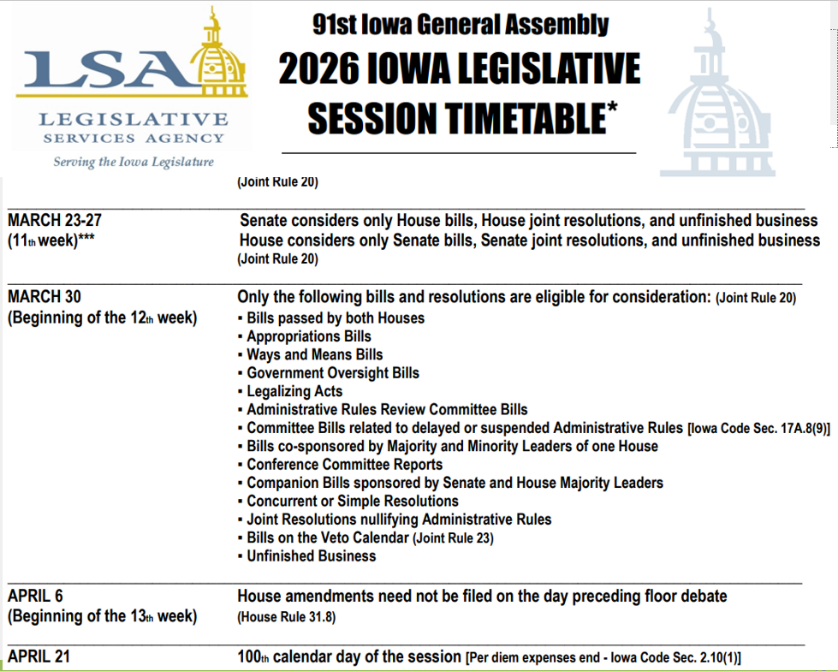
The Session has less than four weeks left before the 100th day, April 21, the expiration of per diem reimbursement for Legislators. Before working on budget bills, the House and Senate typically agree on budget targets that have not yet been announced. Still on their plates before adjournment, the House and Senate will have to pass a state budget (appropriations bills), decide whether to compromise on property tax reform, and finish up the hundreds of policy bills waiting for their attention. There are bills on the Unfinished Business Calendar that may be considered, but those have not always survived both funnel deadlines. With the General Election in November, legislators are further motivated to finish up so they can start campaigning. See the Session Timeline here: https://www.legis.iowa.gov/docs/publications/SESTT/current.pdf
Property Tax Bills, New Bills Numbers and Key Differences
SF 2472 is the new number for the Senate property tax reform plan. This Bill completely overhauls the property tax system. See the March 20 weekly report for even more details. In short, there is no fiscal note yet, so stakeholders can not confirm what will happen to their property taxes. The Senate Ways and Means Committee amendment addressed some concerns by removing some costly provisions for the state that would have provided property tax relief (special education foundation level at 100% and media and education services state aid to replace property taxes). The Bill allows taxpayer statements to be posted rather than mailed, includes two types of senior relief on residential property taxes, phases out rollbacks, lowers the maximum levy rates, and limits the taxing authority of the management fund. This Bill does not include any changes to SAVE. UEN is undecided on this Bill.
HF 2745, Property Taxes by the House, was also amended by the Ways and Means Committee in response to advocacy from school leaders. The Bill no longer includes a supermajority vote originally proposed in HSB 596 for SAVE revenue bonds. With this provision removed from the Bill, the current process for revenue bonds is unchanged. Thank the House Ways and Means Committee members for removing this provision! The amendment also extends SAVE through December 31, 2070, and adds a June special election date for bond issues. UEN supports these provisions. Clarifies which items should be included on taxpayer statements and allows them to be posted online rather than mailed by the county. UEN supports this provision. UEN published a Call to Action this week, encouraging advocacy regarding the Bill’s diversion of SAVE school infrastructure revenues to property tax relief, reaching 30% of total revenue by 2034 (although it stretches out the transition by 4 years longer than in Gov. Reynolds’ plan). The Call to Action also included our opposition to a limitation on spending authority to no more than 35% of the prior year’s expenditures. Find the UEN Call to Action linked here on the UEN website. UEN is undecided on the Bill.
The ISFIS Property Tax Comparison Side-by-Side analysis of the bills can be found linked here.
MAHA Make American Healthy Again Bill with Educational Mandates
HF 2676: The House amended and approved the Governor’s MAHA (Make America Healthy Again) bill, which included several costly, unworkable, and unfunded mandates that would impact school districts. The House approved HF 2676 on March 4; it is already attached to SF 2367, which is on the Senate Calendar. A Fiscal Note was published on March 19, which indicates some, but not all, of the unfunded mandates included in this amendment. All of these stem from a concern for students' health, so we are not questioning good intentions but are sharing the difficulty schools face in complying with the mandates, especially in a year of low SSA and declining enrollment.
Thanks to all who have reached out to Senators. We have seen messages from the Senate indicating its intention to amend the PE and Extracurricular unfunded mandates and to remove the federal nutrition waiver from the Bill. That is progress. Senators also indicate their willingness to hear from stakeholders on concerns about screen time limits.
Div. VII Screentime LImits for K-5 Concerns:
- These limits are costly for districts that follow the state standards in literacy (including reading, tutoring, and writing) and math. The DE has provided the software literacy tools via Amira, and other technology supports for schools for non-proficient students in grades K-12. Schools would have to replace instructional software with textbooks and other materials to comply with these limitations. Teachers and paras will have to deliver literacy and math interventions in person, which increases labor costs. Technology is a great learning tool when adaptive and individualized for students. It also helps teachers provide more individualized and relevant instruction for students in their classrooms. SF 2355, School Technology Taskforce, on the House Calendar, would be a necessary first step for Iowa to study the impact of any changes in the use of technology for instruction and the impact on students. Iowa DE’s webpage explains the value of individualized technology instruction in Sept. 2025, which 105,000 students in 250 school districts had used: “With support from Gov. Kim Reynolds, the Iowa Department of Education has announced expanded access to Reading Assistant, an innovative literacy tool designed to strengthen reading skills for elementary students. Expanded access will allow more Iowa schools to assist English Learners and Tier I, Tier II and Tier III students.”
- If the screentime limitations are going to move forward without the Senate’s study first, we would encourage adding a few more exceptions and a slightly longer limit for later elementary (grades 4-5). Additional exceptions:
- Foreign language or English-language Learner interactive software
- Talented and gifted student programs with individualized acceleration
- Individualized and interactive interventions to comply with math and reading state plan processes.
- Local district assessments
- For grades 4+, exception for group and project-based assignments.
See the UEN Call to Action linked on the website.
Floor Action in the House and Senate
HF 2230 DE’s Teacher Prep Bill: requires all teacher preparation programs to administer an end-of-program test to all teacher candidates. Passing the test is not required for graduation or a license, but it will be reported to DE. Requires prep programs to provide remediation to teachers who do not attain the cut score. Requires DE to collect and publish program passage rates and report on remediation efforts. DE will use the test results for curriculum improvements and prep program evaluation. Requires prep programs to incorporate hands-on clinical experiences for all teacher candidates on IEPS, plus structured mentoring support for first-year SPED teachers and administrators. Proposes some specific competencies and experiences for all educator candidates regarding EL instruction. House passed it, 94:2. Attached to SF 2222 on the Senate Calendar. UEN is undecided.
HF 2725 DE’s Reporting Bill: requires sharing of unit-level wage data for secondary and postsecondary program evaluation, consolidates certain required reports into the Annual Condition of Education Report, changes responsibilities for the future-ready Iowa last-dollar scholarship report, changes IWD data-sharing provisions, and creates a return-on-investment reporting system to be overseen by the Iowa Student Aid Commission. House passed it, 97 to 6. Attached to SF 2407 on the Senate Calendar. UEN is undecided.
SF 2220 TAG, Advanced Math Pathways and Accelerated Learning: SF 2220 DE’s TAG and Advanced Pathways Bill: Amended by House, S-5132:
- ISASP: moves state science testing from 10th grade to 11th grade.
- Talented and Gifted (TAG): Requires school districts to establish systematic and uniform procedures for screening, referring, identifying, and serving TAG children, based on evidence from multiple data sources. Prohibits any one criterion from being used to deny TAG services to an otherwise qualified student. Requires school districts to provide education service options for TAG students in their area of giftedness. Requires school boards to annually review TAG students’ progress.
- Advanced Pathways: Requires each school district to develop an advanced mathematics pathway designed to increase the number of students who complete higher-level math in grades 9-12. School districts are required to automatically enroll a student in an advanced mathematics pathway if certain conditions are met, unless parents opt out. The amendment limited the automatic enrollment in the next most rigorous course offered by the district to apply only to students who meet all of the following criteria:
- enrolled in grades 4-12,
- attained a score that is within the advanced performance level on the statewide summative assessment in mathematics or English language arts that was administered to the student in the immediately preceding school year,
- the school district determines that the student demonstrates academic preparedness using any of the following data sources: Standardized assessments, student achievement, cognitive ability, creative ability, qualitative and quantitative data, teacher and parent input, observation of gifted characteristics and behaviors, and
- the school district determines that the student is prepared to participate in the next most rigorous level of advanced courses or programs offered by the school district.
- Subject and Whole Grade Acceleration: Requires school districts to establish and implement procedures for subject acceleration and whole-grade acceleration. Any student enrolled in grades 4-12 who meets all of the requirements outlined in the Bill as amended, including but not limited to advanced performance level achievement on the ISASP in mathematics or English language arts and demonstrating academic preparedness, shall be automatically enrolled in the next most rigorous level of advanced courses of programs offered by the school district in the next school year.
- Unfunded Mandates: Requires school districts to pay costs required by the Bill as amended from State Foundation School Aid per Iowa Code section 25B.2 (state mandates).
- Delayed Implementation: advanced mathematics pathway, grade acceleration, and automatic enrollment in advanced courses apply to school years beginning on or after July 1, 2027.
The Bill was amended and approved by the House 84 to 11. UEN is registered as undecided but appreciates the expanded criteria and delay of implementation to July 1, 2027.
SF 2086 - Junior Fire Fighter Program for High School Students
Allows school districts (does not mandate) to have a Jr. Firefighter Program for students in grades 11-12; requires districts with a program to have an agreement with the local fire department to provide appropriate materials and training. Allows the students to take the certification examination but prohibits them from receiving the certificate until they are 18 years old. The program can be offered as an extracurricular activity or CTE program. Requires students to submit a waiver of liability. Requires all instructors to pass a background check. Specifies in extraordinary detail the contents of the course. Approved by the Senate, 47 to 0. Approved by the House 95 to 0. Now to the Governor. UEN supports.
HF 2522 Local Government Public Officer Insurance Policy: under current law, certain public officers are required to obtain a bond that runs to the state for the use and benefit of anyone injured or sustaining loss, with a right of action in the name of the state for injured person’s (or corporation’s) use. (Code 13 section 64.18). In 2024, an enacted bill allowed public officers to obtain an insurance policy instead. This Bill strikes IC 64.18, which would mean bonds are required rather than an insurance policy for public officers. The House passed the Bill 86 to 0. The Senate passed it, 47-0. Now to the Governor. UEN is undecided.
SOS List of Primary Candidates is Out – Advocacy Assignment
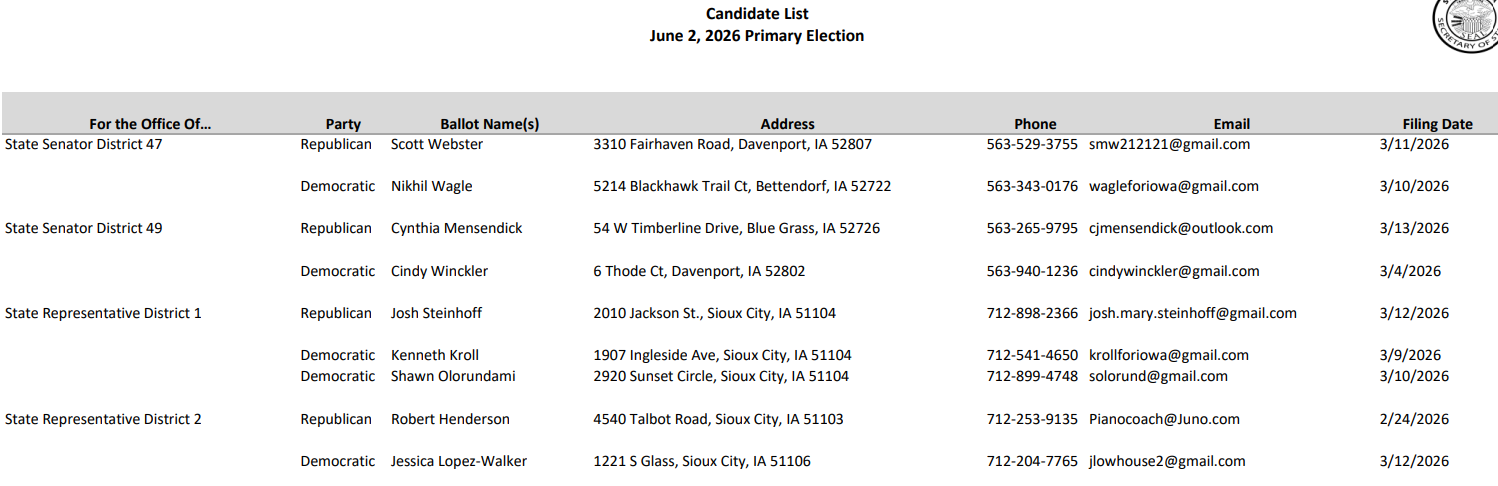
Sec. of State, Paul Pate, has posted the list of candidates qualified to run in the 2026 June primary election. Find the document posted on the SOS website here: https://sos.iowa.gov/news-resources/state-and-federal-candidates-are-set-june-primaries
The spreadsheet lists key contact information, including phone numbers, home addresses, and campaign email addresses, all of which may be more reliable for connecting with candidates after the Session concludes and before the election. We encourage school leaders to look into who’s running, reach out to all candidates, and ask them their vision for public education and how they plan to adequately support school districts and their students, with adequate funding and local flexibility. UEN will develop supporting tools, such as sample questions and agenda templates for a local forum. See a sample section of the list here:
Advocacy Actions This Week
- Property Tax Reform: Ask legislators how the conversation is going. What questions do they have? Encourage legislators to get fiscal estimates before proceeding with big system changes. The impact of multiple changes to all three components of the system is very hard to predict. If reform reduces revenue, it is property tax relief that will likely compel local governments to reduce services. See the UEN Call to Action on Property Tax Reform, including SAVE Diversion and UAB limitations.
- Unfunded Mandates: Reach out to Senators about the MAHA bill, HF 2676, which also has an active UEN Call to Action. The House added provisions mandating PE every day for students (most elementary schools will have to double the number of PE teachers, already a shortage area, and do not have enough gym space to implement it). The House amendment also mandates that every high school student participate in an extracurricular activity, including a signed contract with students and parents. Although we know activities are important for engaging students, some students are working to financially support their families, others are taking care of a sibling while their parents work, and others are involved in outside activities (such as dance, private voice lessons, or club sports). There will be costs associated with increasing stipends for additional coaches, transportation, equipment, uniforms, officials' fees, and tournament entry fees if all participate. We are advocating for additional exceptions to the screen time limits in the Bill for K-5 students (e.g., EL, foreign language, local assessments, and interventions for math and reading, as examples).
- Student Behavior Bills: SF 2428 and HF 2538 are both in play. See the section above for specifics. Advocate for eliminating the oversight committee review recommendation to return each removed student to the classroom, which is unworkable. Encourage training supports for IEP team members. Advocate for greater local control over who attends the IEP team meeting, with the primary goal of convening quickly and accommodating parents. Request the removal of the mandate that every teacher read and sign off on every IEP, which is not the best way to support teachers in understanding necessary accommodations and learning goals for students with disabilities.
Thank legislators for the bills moving forward that UEN supports!
Connecting with Legislators: To call and leave a message at the Statehouse during the legislative session, the House switchboard operator number is 515.281.3221 and the Senate switchboard operator number is 515.281.3371. You can ask if they are available or leave a message for them to call you back. You can also ask them for the best way to contact them during the session. They may prefer email, text message, or a phone call, based on their personal preferences.
Find out who your legislators are through the interactive map or address search posted on the Legislative Website here: https://www.legis.iowa.gov/legislators/find
Other UEN Advocacy Resources:
Check out the UEN Website at www.uen-ia.org to find Issue Briefs, these UEN Weekly Update Reports and Videos, UEN Calls to Action when immediate advocacy action is required, testimony presented to the State Board of Education, the DE or any legislative committee or public hearing, and links to fiscal information that may inform your work. The latest legislative actions from the Statehouse will be posted at: www.uen-ia.org/blogs-list. The 2026 UEN Advocacy Handbook will be available and posted soon at www.uen-ia.org/advocacy-handbook.
Contact Us
Margaret Buckton
UEN Executive Director
margaret@iowaschoolfinance.com
515.201.3755 Cell
Thanks to our 2025-26 UEN Corporate Sponsors:
Special thank you to your UEN Corporate Sponsors for their support of UEN programs and services. Find information about how these organizations may help your district on the Corporate Sponsor page of the UEN website at www.uen-ia.org/uen-sponsors.
- 10Fold Architecture + Engineering - www.10foldarchitecture.com
- INVISION Architecture - www.invisionarch.com
- Solution Tree - www.solutiontree.com/st-states/iowa